Cracking the Code: How to Read a Tyre Size Like a Pro
Ever looked closely at the side of your car’s tyres? Amidst the brand names and safety warnings, you’ll find a seemingly cryptic string of numbers and letters, like 185/75 R14 89T or 205/55 R16 91V.
If you aren't an auto mechanic, it looks like a random math equation. But these numbers are actually the "DNA" of your tyre.
Understanding how to read tyre sizes isn’t just trivia for gearheads—it’s crucial when you need a replacement, want to upgrade your rims, or simply want to ensure your vehicle is handling safely.
Let's break down this alphanumeric code step-by-step so you can read it like a pro.
Where to Find Your Tyre Size
Before we decode the numbers, you need to find them. The easiest spot is molded directly into the outer sidewall of your current tyres.
However, if your current tyres are worn down or you suspect the previous owner put the wrong size on, you can find the manufacturer’s recommended tyre specifications in a few other places:
- A sticker on the inside of the driver’s side door jamb.
- Inside the fuel filler cap door.
- Inside your glove box door.
- Your vehicle’s owner’s manual.
The Anatomy of a Tyre Code
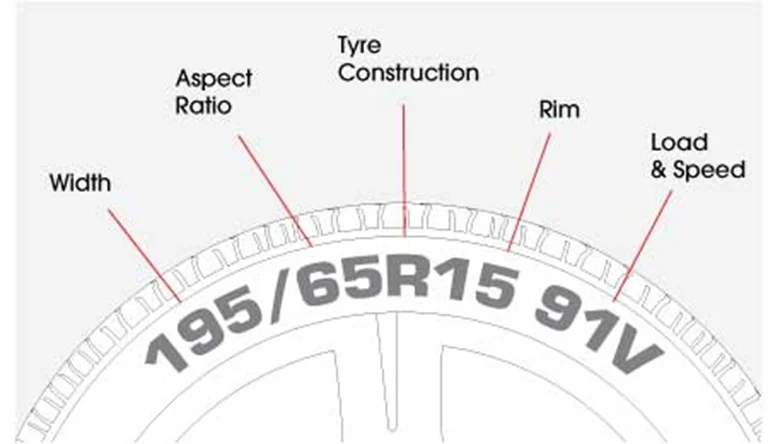
Let’s use a highly common tyre size as our test subject: 185/75 R14 89T.
Here is exactly what each segment of that code means:
1. Width (e.g., 185)
The first three numbers tell you the width of the tyre in millimeters, measured from sidewall to sidewall.
In our example, the tyre is 185 mm wide across the tread. A wider tyre generally means a larger contact patch with the road, which can improve grip but might slightly lower fuel efficiency.
2. Aspect Ratio (e.g., 75)
The two digits following the slash indicate the aspect ratio, often called the profile. This is expressed as a percentage of the tyre's width.
In our example, the profile height is 75% of the 185 mm width (roughly 138.75 mm).
Pro Tip: Lower numbers (like 40 or 45) mean low-profile tyres, which offer sharper handling but a stiffer, bumpier ride. Higher numbers offer more cushioning.
3. Construction Type (e.g., R)
The letter R stands for Radial, which is the industry standard for almost every modern passenger car tyre.
Radial construction means the tyre's internal ply cords run perpendicular (radially) to the direction of travel, offering better fuel economy, a smoother ride, and longer tread life.
4. Rim Diameter (e.g., 14)
The next number tells you the size of the wheel rim that this tyre is designed to fit, measured in inches.
Our example tyre is built to fit a 14-inch wheel.
5. Load Index (e.g., 89)
The load index is a numerical code that corresponds to the maximum weight the tyre can support when safely inflated.
| Load Index | kg per tyre | lbs per tyre | Set of 4 (kg) |
|---|---|---|---|
| 89 | 580 | 1,279 | 2,320 |
| 90 | 600 | 1,323 | 2,400 |
| 91 | 615 | 1,356 | 2,460 |
| 92 | 630 | 1,389 | 2,520 |
| 93 | 650 | 1,433 | 2,600 |
| 94 | 670 | 1,477 | 2,680 |
| 95 | 690 | 1,521 | 2,760 |
| 96 | 710 | 1,565 | 2,840 |
| 97 | 730 | 1,609 | 2,920 |
| 98 | 750 | 1,653 | 3,000 |
| 99 | 775 | 1,709 | 3,100 |
| 100 | 800 | 1,764 | 3,200 |
| 101 | 825 | 1,819 | 3,300 |
| 102 | 850 | 1,874 | 3,400 |
| 103 | 875 | 1,929 | 3,500 |
| 104 | 900 | 1,984 | 3,600 |
| 105 | 925 | 2,039 | 3,700 |
| 106 | 950 | 2,094 | 3,800 |
| 107 | 975 | 2,149 | 3,900 |
| 108 | 1,000 | 2,205 | 4,000 |
| 109 | 1,030 | 2,271 | 4,120 |
| 110 | 1,060 | 2,337 | 4,240 |
| 111 | 1,090 | 2,403 | 4,360 |
| 112 | 1,120 | 2,469 | 4,480 |
| 113 | 1,150 | 2,535 | 4,600 |
| 114 | 1,180 | 2,601 | 4,720 |
| 115 | 1,215 | 2,679 | 4,860 |
| 116 | 1,250 | 2,756 | 5,000 |
| 117 | 1,285 | 2,833 | 5,140 |
| 118 | 1,320 | 2,910 | 5,280 |
| 119 | 1,360 | 2,998 | 5,440 |
| 120 | 1,400 | 3,086 | 5,600 |
| 121 | 1,450 | 3,197 | 5,800 |
| 122 | 1,500 | 3,307 | 6,000 |
| 123 | 1,550 | 3,417 | 6,200 |
| 124 | 1,600 | 3,527 | 6,400 |
| 125 | 1,650 | 3,638 | 6,600 |
| 126 | 1,700 | 3,748 | 6,800 |
6. Speed Rating (e.g., T)
The final letter is the speed rating, indicating the maximum speed the tyre can safely sustain under its recommended load capacity.
Like the load index, this matches a standardized scale:
| Letter Code | Maximum Safe Speed | Typical Vehicle Type |
|---|---|---|
| Q | 160 km/h (99 mph) | Winter tyres / 4x4s |
| S | 180 km/h (112 mph) | Family sedans / Vans |
| T | 190 km/h (118 mph) | Family cars / Small SUVs |
| H | 210 km/h (130 mph) | Sporty sedans / Coupes |
| V | 240 km/h (149 mph) | Sports cars / Performance SUVs |
| W / Y | 270+ km/h (168+ mph) | Exotic supercars |
Why Getting the Right Size Matters
When it comes time to buy new rubber, sticking to your vehicle manufacturer’s recommended tyre sizes is vital. Altering the width or profile drastically without changing your wheels can lead to serious headaches:
- Speedometer Inaccuracy: Changing the total diameter throws off your car's computer, meaning your speedometer will read slower or faster than you are actually moving.
- Rubbing: Tyres that are too wide or tall can rub against your brake lines, suspension parts, or wheel arches during sharp turns.
- Safety Risks: An incorrect load index or speed rating can cause the tyre to overheat and fail catastrophically at high highway speeds.
The Bottom Line
Next time you visit a tyre shop or browse for replacements online, you won't have to guess or rely blindly on a salesperson. You have the exact blueprint right on your sidewall.
Just remember: Width → Profile → Construction → Rim → Load → Speed.
Safe driving out there!